GEAR
Oblate Discs: Edible Film for Powdered Supplements
An edible starch film for wrapping powder: where to get it, how to use it, and how it differs from rice paper or pharmacy starch cachets.
An Edible Sheet Instead of a Capsule
Loose powder in your mouth is bitter, gritty, and dusty. Hand-filling capsules takes tens of minutes per batch. There’s a third way, barely known outside a handful of markets: a thin edible starch film you wrap around the powder and swallow in seconds.
What It Is
It’s an ultra-thin sheet made of starch. Dry, it’s stiff and slightly crisp. Once wet, it turns slippery and pliable, then dissolves completely in your mouth or in water within seconds — you don’t chew it and you don’t swallow anything solid besides the powder itself.
The sheet in this material is 8 × 7 cm and weighs 0.14 g, roughly three times lighter than a sheet of printer paper (80 g/m² versus about 25 g/m² here). In Japan this material is called oblaat and has been in use since the late 19th century. In the US it’s sold as oblate discs, or under the brand Blate Papes. In Poland’s retail market it’s practically absent under any name — more on that in the long version below.
Where to Get It
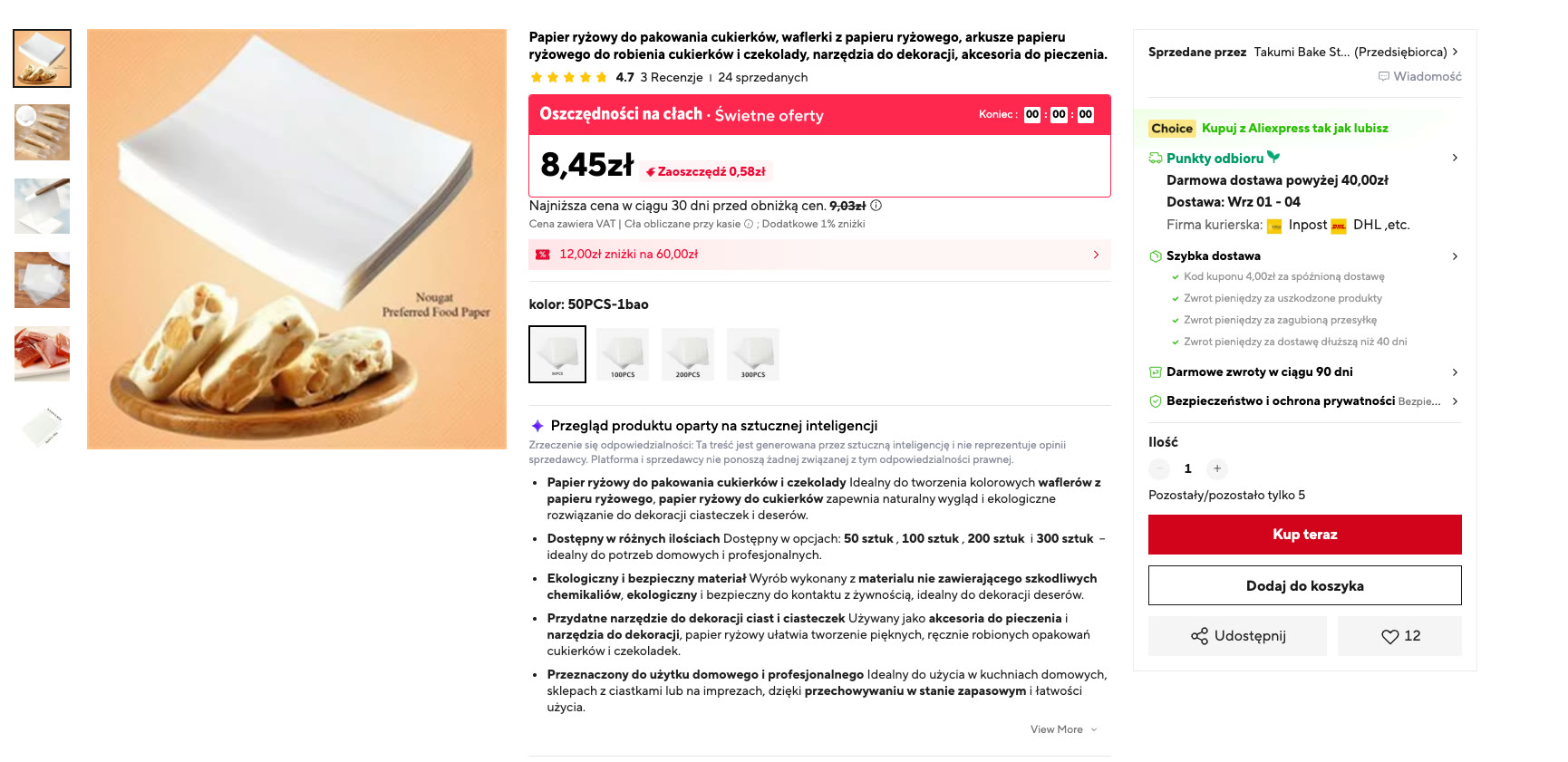
This specific AliExpress listing, 50 sheets for roughly $2, with variants up to 300 pieces. Shelf life is 18 months, and I haven’t seen this sold anywhere else at retail — worth ordering a larger pack right away.
Where the skepticism in that tone comes from: this listing’s own specification lists the material as “Plastic,” while the packaging itself declares starch. The standard printed on the label (Q/ZJY 0001S-2023) is a company standard — registered by the manufacturer itself, not a Chinese national standard. The line “eco-friendly and food-safe” in the product description comes from AI-generated content, which AliExpress explicitly disclaims responsibility for. Buying through AliExpress means importing this yourself, with no EU importer standing behind the ingredient compliance. Photos of the packaging and a translation of the label are below — the rest of the judgment call is yours.
How to Use It
- Fold the sheet and wet one edge.
- Seal the wet edge to form a small pouch. Don’t over-wet it — the sheet dissolves in water.
- Fill the pouch with powder.
- Wet and seal the top edge, closing the portion.
- Swallow it, chasing with water.
The manufacturer’s own instructions on the packaging describe a simpler variant: pour the powder onto the center of the sheet, fold all four edges in toward the middle, dip the whole thing in water briefly, and swallow with warm water. Both methods work — they differ in whether you wet the whole sheet at the end or just the edges while folding.
I show the whole sequence step by step on the Instagram reel.
How Much It Holds, Compared to a Capsule
A size 00 gelatin capsule, the standard for hand-filling, holds about 0.7–1 g of powder. An 8 × 7 cm sheet holds several grams at once and closes in a few seconds, with no capsule-filling machine needed. The sheet itself adds 0.14 g of mass and about 0.5 kcal — negligible for a calorie count.
What’s on the Packaging
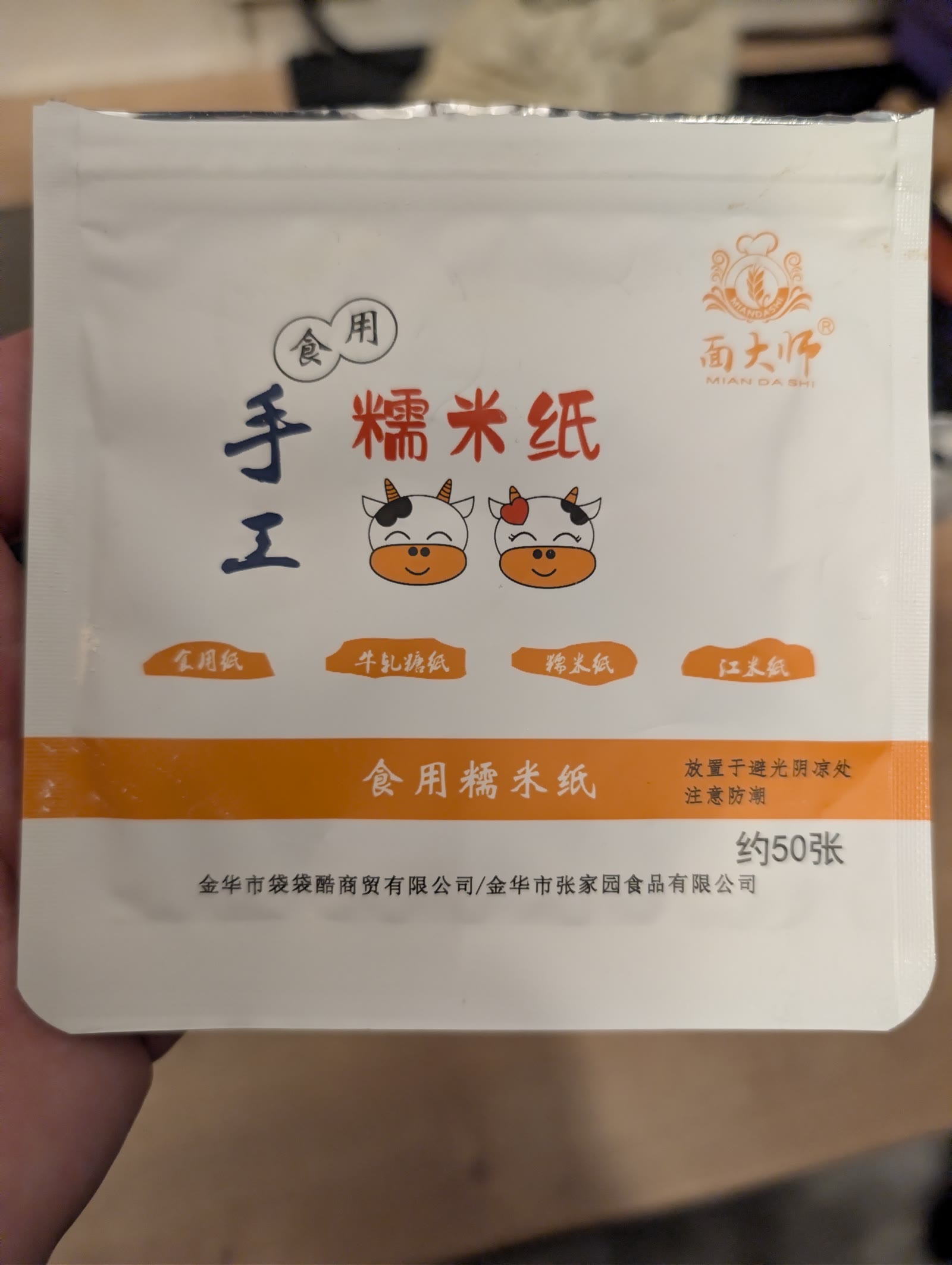
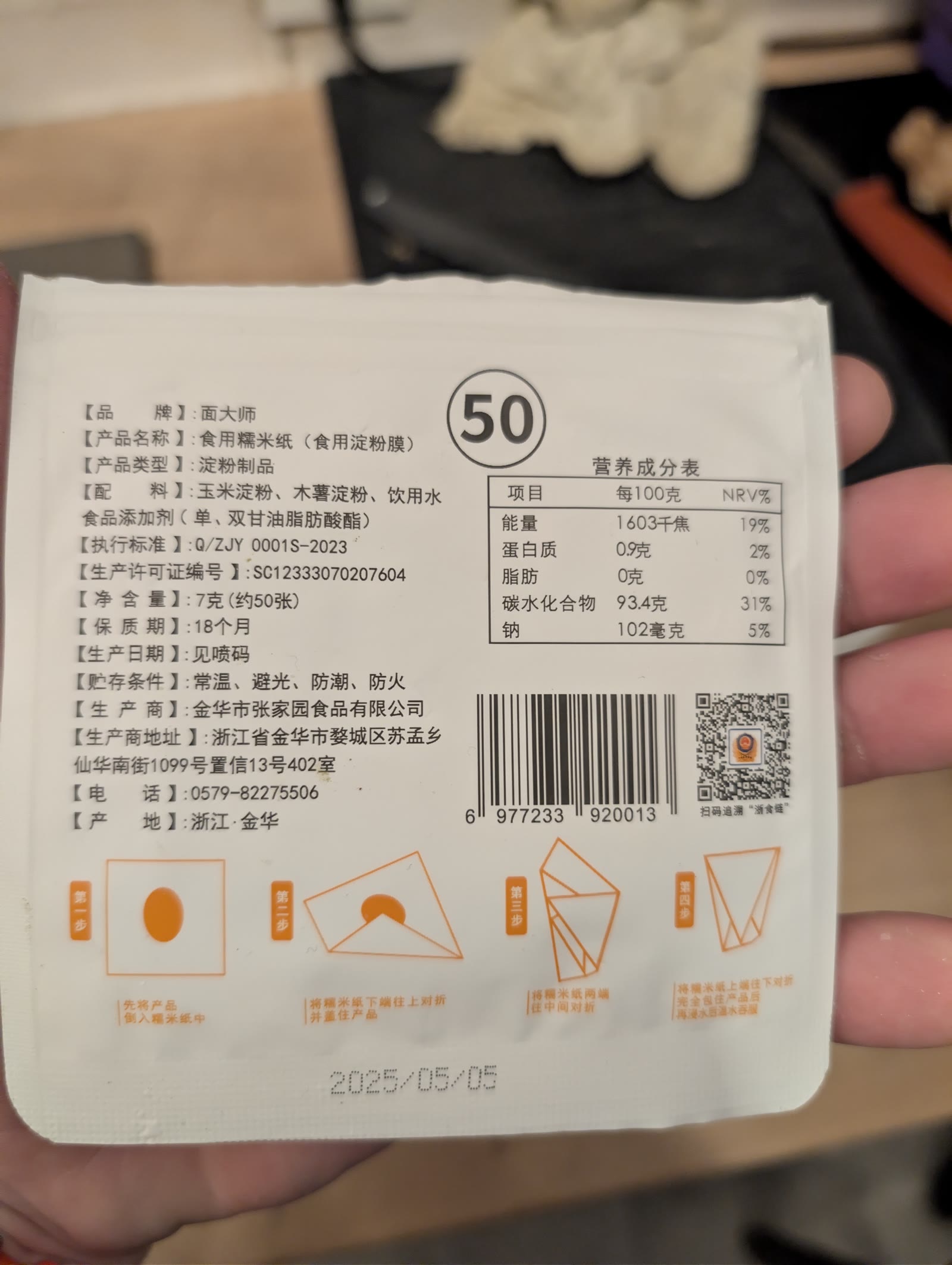
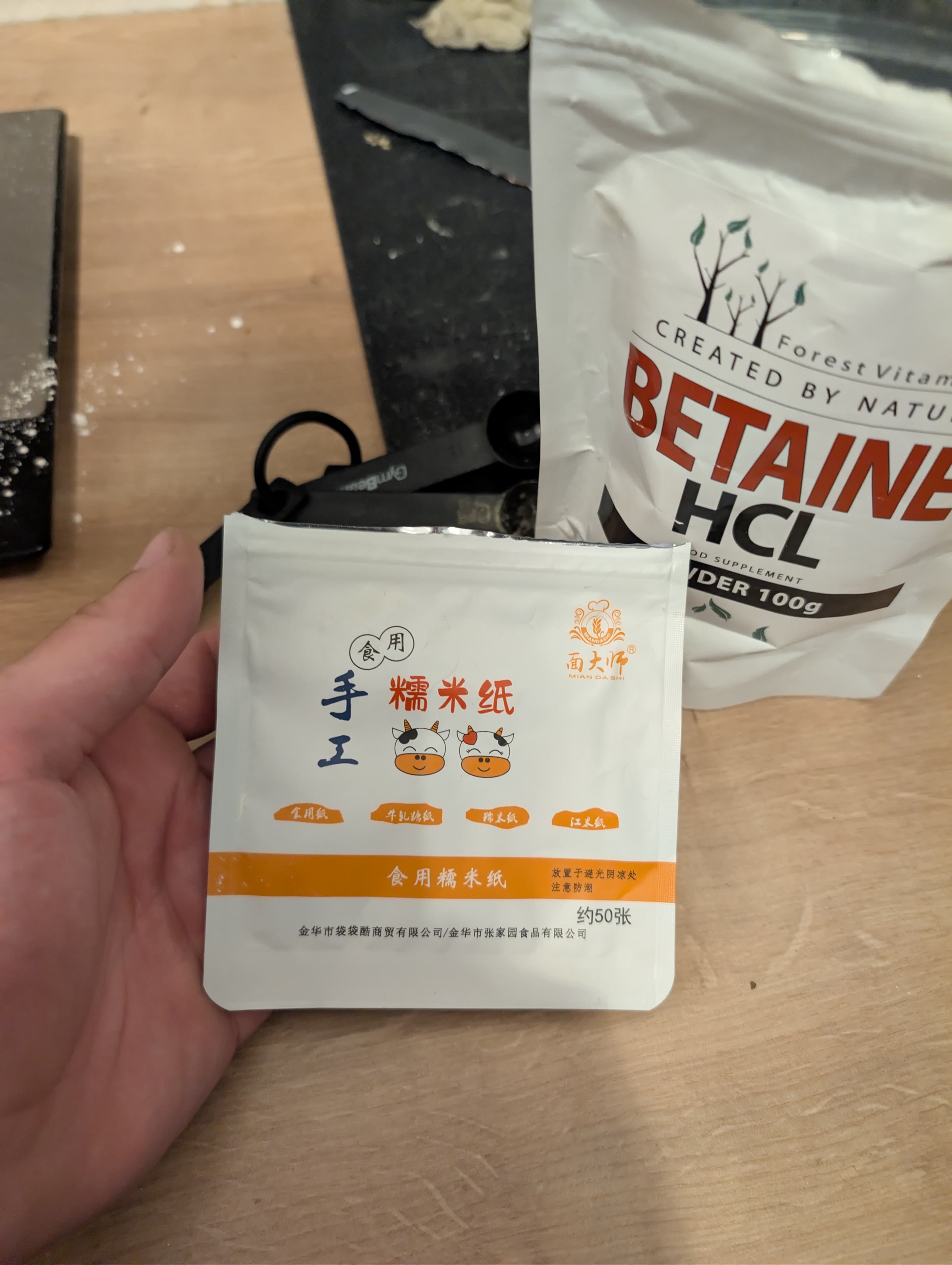
Product name on the packaging: 食用糯米纸 / 食用淀粉膜 — edible glutinous rice paper / edible starch film. Brand: 面大师 (Mian Da Shi). Manufacturer: Jinhua Zhangjiayuan Food Co., Ltd., Zhejiang province.
Ingredients: corn starch, tapioca (cassava) starch, drinking water. Additive: mono- and diglycerides of fatty acids (E471).
| Nutrition | per 100 g | per sheet (0.14 g) |
|---|---|---|
| Energy | 1603 kJ | ~0.5 kcal |
| Protein | 0.9 g | trace |
| Fat | 0 g | 0 g |
| Carbohydrate | 93.4 g | 0.13 g |
| Sodium | 102 mg | trace |
Shelf life: 18 months from production date. Storage: room temperature, away from light, moisture, and fire.
How to Search for It
Searching AliExpress for “oblate” returns nothing — sellers list this as a candy-packaging accessory instead. Search for:
- rice paper candy wrapper
- edible glutinous rice paper
- wafer paper
The same search results also surface products for something else entirely: Xuan calligraphy rice paper, thick A4 sheets for printing on cakes, decoupage rice paper. None of them work for wrapping powder — they’re thicker and don’t dissolve the same way.
Long Version
Details, naming, and context you don’t need in order to use the product.
Naming
In English and Japanese: oblate, oblate discs, oblaat, オブラート, edible film, blate papes. A few competing names circulate in Polish too: jadalne papierki do proszku, opłatki apteczne, papier skrobiowy, papier ryżowy, jadalna folia skrobiowa, opłatki skrobiowe, papier oblatowy.
The Polish Equivalent: Pharmacy Starch Cachets
Poland has its own, older version of the same idea: opłatki apteczne, also known as kapsułki skrobiowe (starch capsules). These are two-part, rigid starch containers, sized 0 through 7, made among others by Pelikan s.c. in Żyrardów.
Under communist-era Poland they sat behind the counter of nearly every pharmacy, used for compounding — a pharmacist would weigh out a powder and seal it inside a ready-made shell. After 1989 mass-produced medication replaced them, and once Poland joined the EU, trading them outside pharmacies became legally impossible. Today they’re available only for pharmacy compounding, not retail sale.
This is the real answer to why this topic is obscure in Poland: a known equivalent existed, but it ended up locked inside a closed pharmacy channel before anyone could popularize it outside that channel. The form differs too — a starch cachet has a fixed volume, a sheet takes whatever portion you give it.
Sources (in Polish): gdziepolek.pl, qapsulki.pl
History
The name comes from the Dutch oblaat, meaning sacramental bread, from the Latin oblātum — “offered.” Dutch pharmaceutical companies brought this material to Japan in the late 19th century, originally to mask the taste of bitter medicine. Its moisture-absorbing property later made it a candy wrapper too — hence its present double life in Japan, as both a medicine accessory and a confectionery material.
Source: Wikipedia: Oblaat
Brands and Ingredients
In the US, this product is sold under the brand Blate Papes. In Japan, manufacturers include PIP, Takikawa, and Kokko. Blate Papes is the name of one specific brand; the material itself is called oblate.
Ingredients vary between manufacturers. Some products, besides starch, add rapeseed oil and soy lecithin — an allergen worth knowing about if you react to soy. The material in this article declares mono- and diglycerides of fatty acids (E471) instead of lecithin.
A separate branch is edible film for creative food service, like products from the brand 100% Ingredients — positioned for snacks and desserts, not supplements. I don’t treat those as a substitute for this use case.
FAQ
Is this rice paper? The trade name suggests it, but the ingredients are usually corn or potato starch, not rice. See the comparison table below.
Does it have a taste? Almost none. Slightly starchy, gone within seconds of getting wet.
Is it the same thing as a capsule? Not mechanically. A capsule has a fixed, ready-made volume. You shape a sheet around whatever portion you’re using.
Can this be used for medication? Don’t change the form of a medication without checking with a doctor or pharmacist first. This is an accessory for food powders, not medical advice.
Can I buy this in Poland? Practically not at retail. The only channel I’ve confirmed is import, mainly through AliExpress.
Can I make this at home? In theory, yes, from starch and water alone, but without an industrial machine the sheet comes out thicker and less even than the factory version. I haven’t tested this myself.
Where this article draws the line: this is an accessory for taking powder, not medical advice. Same as with training — I refer a suspected problem to a specialist instead of guessing.
What Not to Confuse This With
| Name | What It Actually Is |
|---|---|
| this product (糯米纸 on the packaging) | film made of corn and tapioca starch, ~25 g/m², no rice despite the name |
| rice paper for printing (candy/cake decor) | a confectionery wafer, 0.3–0.6 mm, made for edible-ink printers |
| rice paper for spring rolls (bánh tráng) | a thick sheet meant to be soaked and wrapped around food |
| Xuan rice paper | paper for calligraphy and painting, not edible |
| Silesian wafers (oblaty śląskie) | a Polish confection |
| Christmas wafer (opłatek) | a wheat-based wafer, a Polish Christmas Eve tradition |
| pharmacy starch cachets (opłatki apteczne) | a two-part rigid shell, available only for pharmacy compounding |