SPORT SCIENCE
NEUROLOGICAL BOTTLENECKS TO MOTOR LEARNING
Why comp kids hold a permanent movement advantage. An exploration of LTAD, FMS, and early diversification vs. early specialization.
Why Comp Kids Hold a Permanent Movement Advantage
Your motor neurons are basically done with myelination by the time you finish puberty. This essentially means that the nerves that go from your brain and spinal cord to your muscles have completed their wiring.
Neuroplasticity research has demonstrated that there remains some capacity to rewire our sensorimotor system, but only with difficulty. True change requires an unbelievable amount of time, conscious effort, and volume.
So, generally speaking, in terms of range of motion and the execution of previously learned motor patterns, you’re stuck with what you’ve got at the end of puberty.
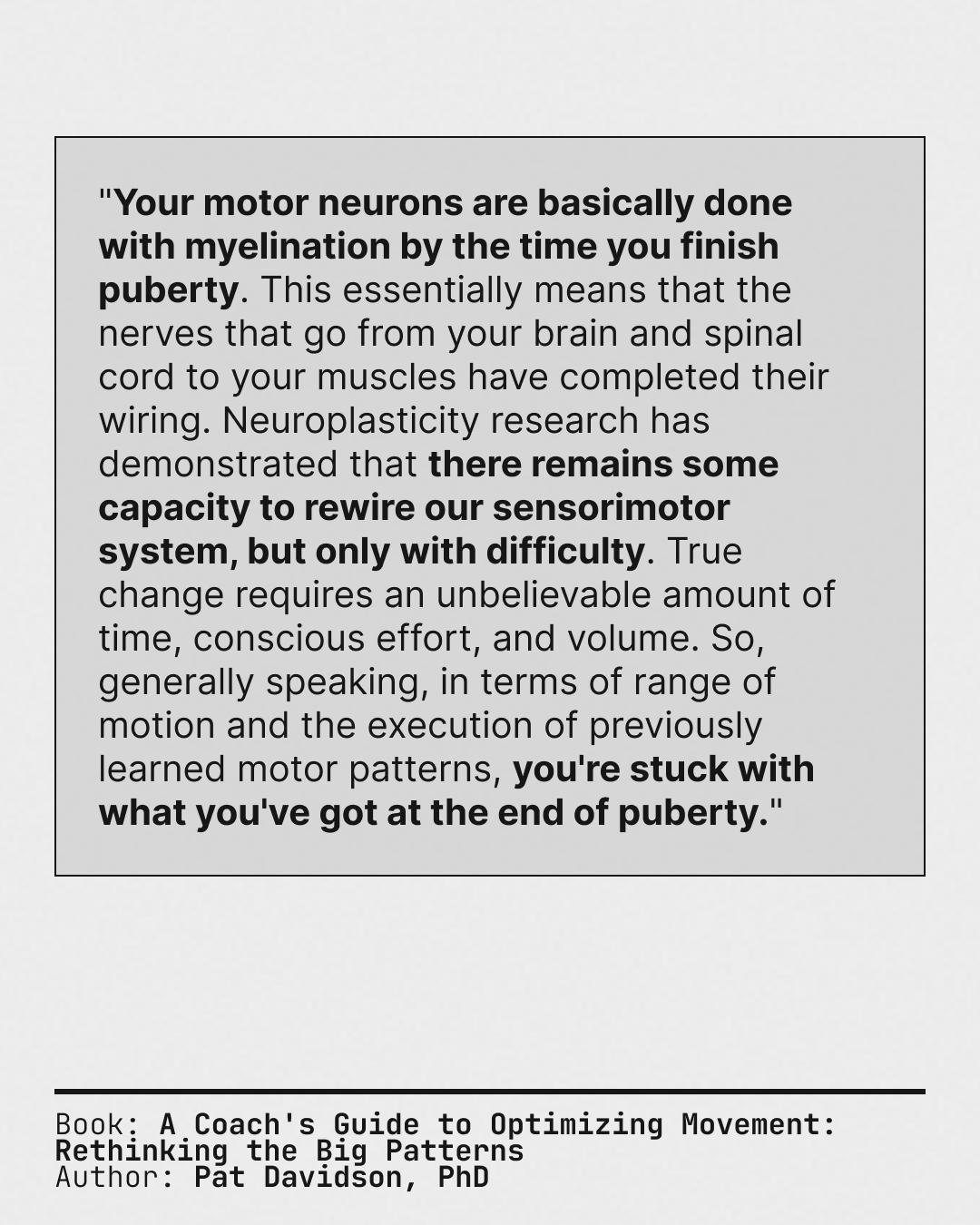
Source: A Coach’s Guide to Optimizing Movement
Long-Term Athlete Development Model (LTAD)
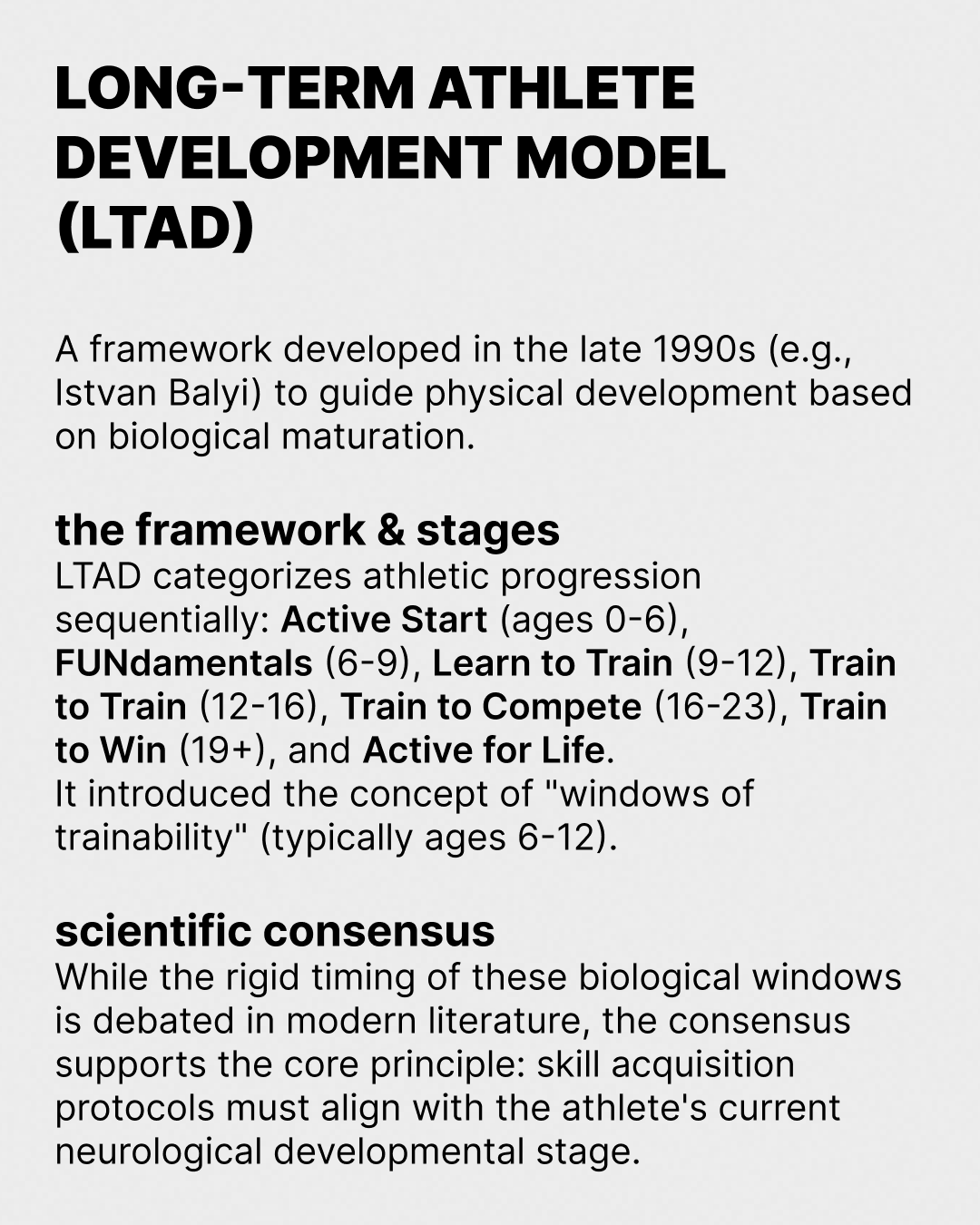
A framework developed in the late 1990s (e.g., Istvan Balyi) to guide physical development based on biological maturation.
The framework and stages:
- Active Start (ages 0-6)
- FUNdamentals (6-9)
- Learn to Train (9-12)
- Train to Train (12-16)
- Train to Compete (16-23)
- Train to Win (19+)
- Active for Life
It introduced the concept of “windows of trainability” (typically ages 6-12).
LTAD Framework stages and scientific consensus
Scientific Consensus
While the rigid timing of these biological windows is debated in modern literature, the consensus supports the core principle: skill acquisition protocols must align with the athlete’s current neurological developmental stage.
Key Concepts
- LTAD (Long-Term Athlete Development)
- FMS (Fundamental Movement Skills)
- Early Diversification vs. Early Specialization
In practice, neurological bottlenecks in training do not resolve themselves. If you add volume and intensity, load management and autoregulation in sport are the guardrails; otherwise you just engrave bad patterns.
Source: A Coach’s Guide to Optimizing Movement: Rethinking the Big Patterns by Pat Davidson, PhD