JOURNAL
Foot and Lower Limb Biomechanics — MSST 2026
Notes from the Move Strong Stand Tall workshop: foot and lower limb biomechanics, new concepts, and a review of What the Foot.
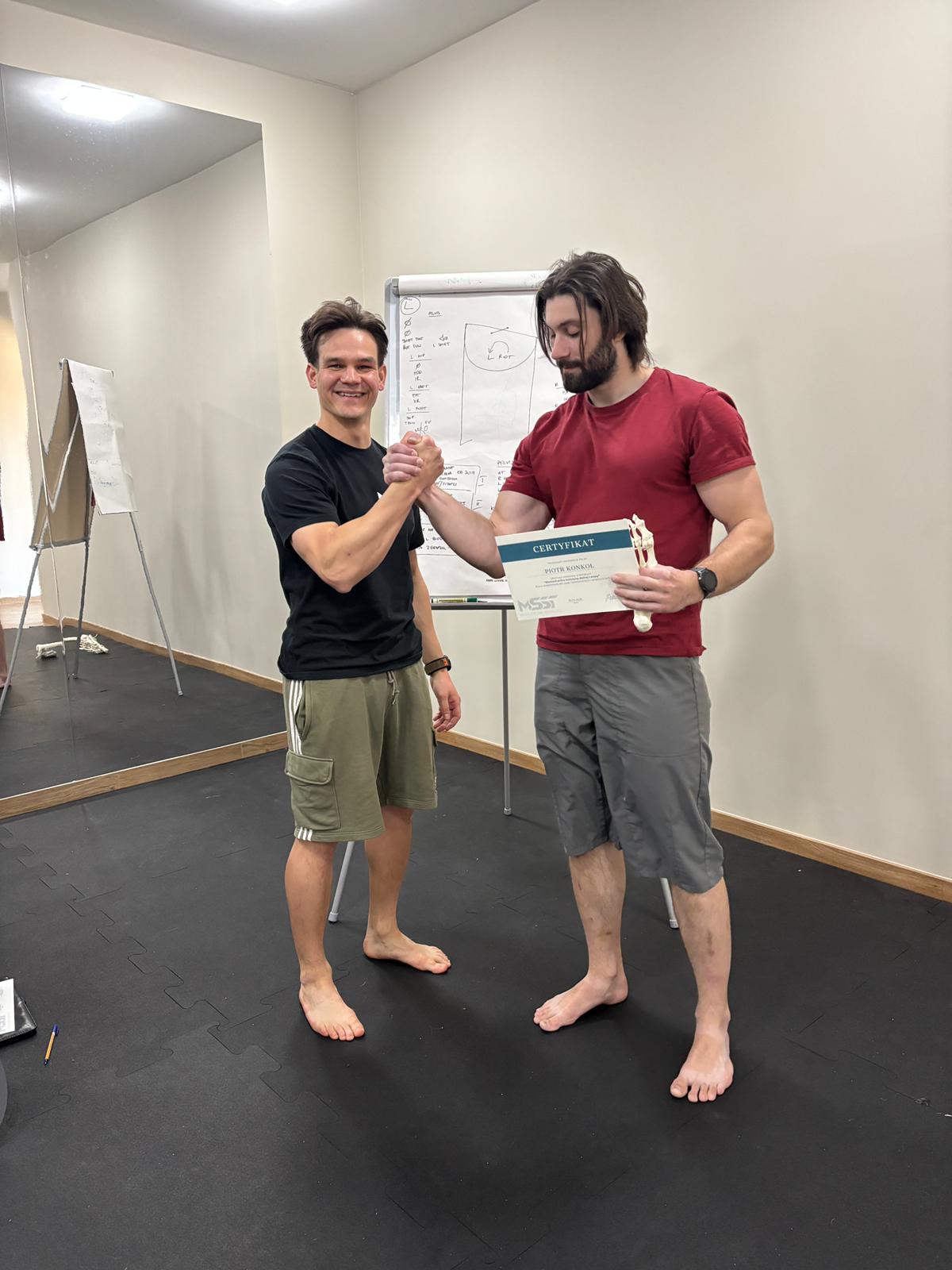
What I learned
- New drills mapped directly to phases in the Flow Motion Model. They help even out asymmetries, expand range of motion, and activate the right muscles for each phase.
- Static asymmetry assessment - a very valuable practice that helps pinpoint primary deficits.
- The working philosophy inside the pattern re-education protocol and how to apply the model.
- A deeper understanding of foot mechanics and its integration with the rest of the kinetic chain (knee and hip). The higher segments will be covered in a related workshop - Biomechanics of the trunk and upper limb.
- A step lasts 0.6-0.7 s, and the body runs through a full cycle of pronation/supination and hip flexion/extension in that time.
- 3D stretching: for example, the iliopsoas is usually stretched only in the sagittal plane, but adding an arm raise and trunk rotation also engages the frontal and transverse planes.
New concepts
- The center and perceived center - if the body senses a missing range, it artificially limits it and sets itself in the perceived center. Often it is enough to show the nervous system that the larger range is available, and movement improves immediately.
- Muscles must lengthen before they can contract.
- Joints act (ACT), muscles react (REACT).
- Pronation in gait is not driven by muscles - it is enough to let gravity do its job and absorb the step.
- Pattern re-education protocol:
- show and teach the movement.
- mobilize manually and show the movement.
- show the movement in a longer range.
What was missing
- Dynamic gait analysis. The instructor said he teaches the methods that work best in practice, and once you process them in static conditions, there is usually no need to go dynamic.
Review: What the Foot - Gary Ward
Before the workshop I worked through What the Foot by Gary Ward, the creator of Anatomy in Motion. It made the practical material on the floor much easier to absorb.
Book takeaways
- A large part of the book reads like a pitch for courses (“how many people we have helped”).
- The formatting feels like an influencer ebook rather than a serious production.
- The author did a lot of useful work with pedobarography (a platform that measures foot load distribution).
- This is a different view of gait than what you see in academic biomechanics texts. It is much more practical and focused on dependencies across the chain from the feet to the head. The most interesting part, the Flow Motion Model gait phases, is described only briefly, and the book sends you to courses for details.
Facts and quotes
One foot has 33 joints and 26 bones.- Ward’s gait phase categorization:
- strike phase
- suspension (load) phase
- transition phase
- shift phase
- propulsion phase
- swing phase
Key concepts
-
Illusion of dysfunction (Rule of 100%) Compensation is not dysfunction. It is a perfect adaptation of the nervous system that picks the path of least resistance in a given situation to keep you upright.
-
Pronation as a glute activator The fitness industry demonizes pronation and locks feet into rigid insoles. Work on the foot often fixates on supination, which creates stiff, overactive feet. Gait physics says otherwise: foot pronation forces hip flexion, adduction, and internal rotation, which allows the glute to be loaded eccentrically.
-
Myth of a neutral spine Do Jefferson curls and side bends. No mercy.
Nomenclature and movement abbreviations
- Fx - flexion
- Ext - extension
- Abd - abduction
- Add - adduction
- IR - internal rotation
- XR - external rotation
- DFx - dorsiflexion
- PFx - plantarflexion
- Ev - eversion
- Inv - inversion
- AT - anterior tilt
- PT - posterior tilt
- Pro - pronation
- Sup - supination
- Hike - elevation
- Drop - depression
- Shift - shift
- Rot away/towards - rotation away/towards
- Lfx - lateral flexion